Accounting Multiple Choice Question – 15 November 2017

The home of multiple choice questions for all your KS3, KS4 and KS5 Business Studies, Economics and Accounting requirements.

Which best describes the net present value method of investment appraisal?

Select ONE answer:

  1. The profit from an investment equal to the initial outlay
  2. The amount of the discounted return on an investment
  3. The amount of the discounted value of inflows from an investment
  4. The investment required to produce a positive return on an investment
  5. The rate to produce a positive return on a proposed investment

What are the advantages and disadvantages of the NPV method?
……………………………………………………………………………………………………………………………………………………………………………………………………………………………………………………………………………………

This is multiple choice question is suitable for Accounting KS5 classes.

The answer is 2 – Net present value (NPV) is determined by calculating the costs (negative cash flows) and benefits (positive cash flows) for each period of an investment. After the cash flow for each period is calculated, the present value (PV) of each one is achieved by discounting its future value at a periodic rate of return (the rate of return dictated by the market). NPV is the sum of all the discounted future cash flows. Because of its simplicity, NPV is a useful tool to determine whether a project or investment will result in a net profit or a loss. A positive NPV results in profit, while a negative NPV results in a loss. The NPV measures the excess or shortfall of cash flows, in present value terms, above the cost of funds. In a theoretical situation of unlimited capital budgeting, a company should pursue every investment with a positive NPV.

Creative Commons License
This work is licensed under a Creative Commons Attribution 4.0 International License.
Accounting Multiple Choice Question – 14 November 2017

The home of multiple choice questions for all your KS3, KS4 and KS5 Business Studies, Economics and Accounting requirements.

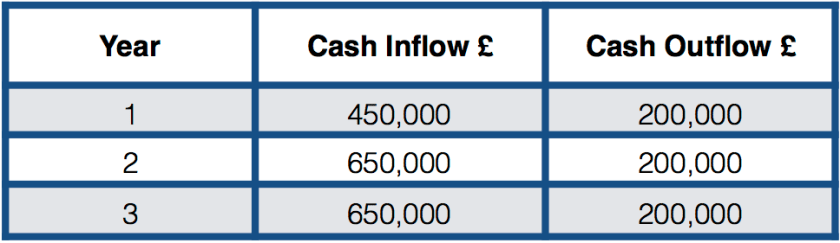
A business is considering investing in new machinery. The machinery will cost £850 000. The cash flows are shown below and are assumed to accrue evenly during the year.

Table 13

Select ONE answer:

  1. 1 year 89 days
  2. 1 year 324 days
  3. 2 year 33 days
  4. 2 years 122 days
  5. 3 years 54 days

Show your workings to arrive at your answer, and explain and justify your reasons:
……………………………………………………………………………………………………………………………………………………………………………………………………………………………………………………………………………………

This is multiple choice question is suitable for Accounting KS5 classes.

The answer is 4 – Y0 cash outflow is £850k to buy the machine. After Y1, there was a net cash inflow of £250k (£450k – £200k) leaving a balance of the initial investment of negative £600k. After Y2, there was a net cash inflow of £450k (£650k -£200k) leaving a balance of the initial investment of negative £150k. Therefore in Y3 there is £150k to recoup on a linear basis and if the net cash inflow remains £450k (£650k -£200k) means that you will have repaid the investment at 2 years + (£150k / £450k) * 365 days which is 122 days rounded up.

Creative Commons License
This work is licensed under a Creative Commons Attribution 4.0 International License.

Accounting Multiple Choice Question – 13 November 2017

The home of multiple choice questions for all your KS3, KS4 and KS5 Business Studies, Economics and Accounting requirements.

Which one of the following is not an example of a cost driver in activity based costing?

Select ONE answer:

  1. Number of boxes of finished goods shipped
  2. Number of direct labour hours
  3. Number of machine set-ups
  4. Number of production runs
  5. Number of quality inspections

Explain and define activity-based costing?……………………………………………………………………………………………………………………………………………………………………………………………………………………………………………………………………………………

This is multiple choice question is suitable for Accounting KS5 classes.

The answer is 2 – An activity cost driver is a factor that influences or contributes to the expense of certain business operations. In activity-based costing (ABC), an activity cost driver drives the costs of labor, maintenance or other variable expenses. Cost drivers are essential in ABC, a branch of managerial accounting that allows managers to determine the costs to perform an activity at various activity levels. The most common cost driver has historically been direct labor hours. Expenses incurred relating to the layout or structure of a building or warehouse may utilize a cost driver of square footage to allocate expenses. More technical cost drivers include machine hours, the number of change orders, the number of customer contacts, the number of product returns, the machine setups required for production or the number of inspections.

Creative Commons License
This work is licensed under a Creative Commons Attribution 4.0 International License.

Accounting Multiple Choice Question – 12 November 2017

The home of multiple choice questions for all your KS3, KS4 and KS5 Business Studies, Economics and Accounting requirements.

Which formula is used to calculate the overhead absorption rate?

Select ONE answer:

  1. Actual overheads / actual activity
  2. Actual overheads / budgeted activity
  3. Budgeted overheads / actual activity
  4. Budgeted overheads / budgeted activity
  5. Budgeted overheads / managed activity

What is the purpose of the overhead absorption rate?……………………………………………………………………………………………………………………………………………………………………………………………………………………………………………………………………………………

This is multiple choice question is suitable for Accounting KS5 classes.

The answer is 4 – Overhead absorption rates are our attempt at coming up with the best ‘guess’ of how much overhead should be given to a product. In traditional costing systems, the rates are likely to be based on machine hours or labour hours. The process is a little more refined in activity based costing, but the intention is still the same: we are trying to find an equitable way of sharing out the overheads to products and are therefore looking for a method that relates the absorption base to the incidence of the overheads (establish a ‘causal link’). If a business is machine intensive, machine hours would be the most appropriate base as the overheads would be related to machine usage. But this is taking a very wide view: it would be better to break the business down into separate departments and choose individual rates for each department. In order for the business to move along and not wait a full year before it can sell its products we need to forecast the overheads and forecast the total hours to be used when making all of our products (assuming a traditional system), in other words we work with budgeted figures when calculating the overhead absorption rates. The formula to use is Overhead absorption rate = budgeted overhead/budgeted activity.

Creative Commons License
This work is licensed under a Creative Commons Attribution 4.0 International License.

Economics Multiple Choice Question – 11 November 2017

The home of multiple choice questions for all your KS3, KS4 and KS5 Business Studies, Economics and Accounting requirements.

The price elasticity for a product is -2.5. The firm sells 2,000 units. What would you expect the new sales to be following a 10% price increase?

Select ONE answer:

  1. 1,500
  2. 2,000
  3. 2,500
  4. 2,200
  5. 1,800

Show your workings to arrive at your answer, and explain and justify your reasons?
……………………………………………………………………………………………………………………………………………………………………………………………………………………………………………………………………………………

This is multiple choice question is suitable for Economics KS5 classes.

The answer is 1 – Normal formula is PED = % change QD / % change P. We know PED = -2.5 & % change in P is 10%. Substituting in this formula we know -2.5 = -x% / 10% where needs to be a higher % therefore this must be -25% / 10% to equal -2.5. 25% of 2,000 units sold is 500 units. 500 less units sold from a 10% increase in price means 2,000 – 500 i.e. new quantity sold will be 1,500 units.

Creative Commons License
This work is licensed under a Creative Commons Attribution 4.0 International License.