

Economics Multiple Choice Question – 10 April 2019

The home of multiple choice questions for all your KS3, KS4 and KS5 Business Studies, Economics and Accounting requirements.

If a government decides to provide health care free at the point of delivery, then:

Select ONE answer:

  1. the demand for health care will be perfectly elastic
  2. health care will become non-rival
  3. some form of rationing will have to be used in the allocation of health care
  4. there will be no opportunity cost involved in the supply of health care

Show your workings to arrive at your answer, and explain and justify your reasons:……………………………………………………………………………………………………………………………………………………………………………………………………………………………………………………………………………………

This multiple choice question is suitable for Economics KS5 classes.

The answer is 3

  1. The demand for health care would still fall should a higher price be charged.
  2. Health care will still be a rival.
  3. Correct: Demand will exceed supply so some method will have to be used to decide who will be treated
  4. There will be an opportunity cost as the resources which will be used could be utilised in producing other goods and services.


Creative Commons License
This work is licensed under a Creative Commons Attribution 4.0 International License.

Economics Multiple Choice Question – 9 April 2019

The home of multiple choice questions for all your KS3, KS4 and KS5 Business Studies, Economics and Accounting requirements.

The information below shows the total cost of production for a firm at different levels of output.

Table 52

What is the average variable cost when 400 units are produced?

Select ONE answer:

  1. £43,75
  2. £87.00
  3. £90.75
  4. £134.50

Show your workings to arrive at your answer, and explain and justify your reasons:……………………………………………………………………………………………………………………………………………………………………………………………………………………………………………………………………………………

This multiple choice question is suitable for Economics KS5 classes.

The answer is 3

  1. AFC
  2. MC
  3. Correct – AVC
  4. ATC


Creative Commons License
This work is licensed under a Creative Commons Attribution 4.0 International License.

Economics Multiple Choice Question – 8 April 2019

The home of multiple choice questions for all your KS3, KS4 and KS5 Business Studies, Economics and Accounting requirements.

In the diagram below demand increases from D to D1. Which area represents the increase in producer surplus?

Diagram 15

Select ONE answer:

  1. XYT
  2. XZU
  3. WTUV
  4. YZUT

Show your workings to arrive at your answer, and explain and justify your reasons:……………………………………………………………………………………………………………………………………………………………………………………………………………………………………………………………………………………

This multiple choice question is suitable for Economics KS5 classes.

The answer is 1

  1. The original producer surplus.
  2. The new producer surplus.
  3. Not part of producer surplus.
  4. Correct: XZU – XYT.


Creative Commons License
This work is licensed under a Creative Commons Attribution 4.0 International License.
Economics Multiple Choice Question – 7 April 2019

The home of multiple choice questions for all your KS3, KS4 and KS5 Business Studies, Economics and Accounting requirements.

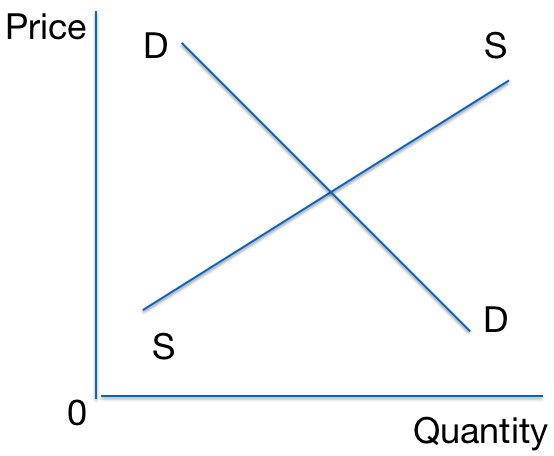
Which of the following combinations of causes and consequences in the market for good X is correct?

Select ONE answer:

  1. Cause – A government subsidy is given to firms producing good X / Consequence – There is a movement down the supply curve for good X
  2. Cause – The price of good X decreases / Consequence – The demand curve for good X shifts to the right
  3. Cause – The price of a substitute for good X increases / Consequence – The demand curve for good X shifts to the left
  4. Cause – The wages paid to workers producing good X fall / Consequence – The supply curve for good X shifts to the right

Show your workings to arrive at your answer, and explain and justify your reasons:……………………………………………………………………………………………………………………………………………………………………………………………………………………………………………………………………………………

This multiple choice question is suitable for Economics KS5 classes.

The answer is 1

  1. A government subsidy lowers the costs of production and causes the supply curve to shift to the right. A contraction of the curve is caused by an increase in the price of good X.
  2. A change in the price of the product causes a movement along the demand curve, not a shift.
  3. If the price of a substitute good increases there will be less demand for the substitute and more demand for good X, the demand curve will shift to the right.
  4. Correct: Wages are a cost of production. As costs of production fall, a firm is able to produce more units of product X to the market. The number of units supplied increases and the supply curve shifts to the right.


Creative Commons License
This work is licensed under a Creative Commons Attribution 4.0 International License.

Economics Multiple Choice Question – 6 April 2019

The home of multiple choice questions for all your KS3, KS4 and KS5 Business Studies, Economics and Accounting requirements.

The diagram below represents a situation in which consumers have underestimated the benefits associated with the consumption of a product. The current demand is D and the current supply curve is S.

Diagram 14

Which of the following changes in demand and supply would reduce this under-consumption?

Select ONE answer:

  1. Demand – Extension / Supply – Increase / Price – Decrease
  2. Demand – Increase / Supply – Contraction / Price – Increase
  3. Demand – Decrease / Supply – Contraction / Price – Increase
  4. Demand – Contraction / Supply – Increase / Price – Decrease

Show your workings to arrive at your answer, and explain and justify your reasons:……………………………………………………………………………………………………………………………………………………………………………………………………………………………………………………………………………………

This multiple choice question is suitable for Economics KS5 classes.

The answer is 1

  1. Correct: An increase in supply, reduction in price and extension in supply would result in a greater quantity being consumed.
  2. An increase in demand would increase price but supply would have to extend and not contract to result in a reduction in under-consumption.
  3. A decrease in demand would cause the price to fall rather than increase and will increase the problem of under-consumption.
  4. An increase in supply would cause a decrease in price but an extension in demand rather than a contraction and an extension in demand would be needed to reduce under-consumption.


Creative Commons License
This work is licensed under a Creative Commons Attribution 4.0 International License.