
Accounting Multiple Choice Question – 11 August 2019

The home of multiple choice questions for all your KS3, KS4 and KS5 Business Studies, Economics and Accounting requirements.

An employee of a music store went to a bank and lodged the previous night’s takings, held overnight in the firm’s safe.

This transaction should be recorded in the store’s Cash Book as……?

Select ONE answer:

    Column to Debit                  Column to Credit

  1.     Cash                                              Bank
  2.     Bank                                             Cash
  3.     Cash                                              Cash
  4.     Bank                                             Bank

Show your workings to arrive at your answer, and explain and justify your reasons:

……………………………………………………………………………………………………………………………………………………………………………………………………………………………………………………………………………………

This multiple choice question is suitable for Accounting KS5 classes.

The answer is 2

  1. Not correct
  2. Correct – Lodging cash on hand increases the bank balance (thus requiring a debit entry to increase the asset of bank) and reduces the cash balance (thus requiring a credit entry to decrease the asset of cash).
  3. Not correct
  4. Not correct


Creative Commons License
This work is licensed under a Creative Commons Attribution 4.0 International License.

Economics Multiple Choice Question – 10 August 2019

The home of multiple choice questions for all your KS3, KS4 and KS5 Business Studies, Economics and Accounting requirements.

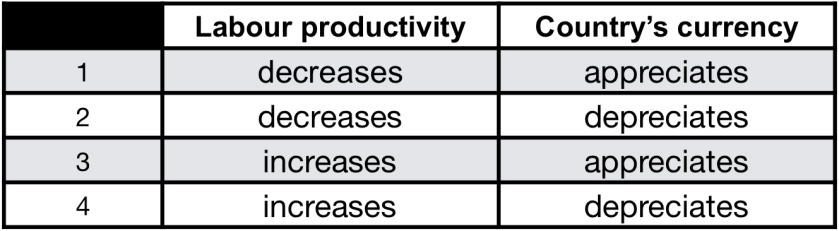
Which of the following combination of changes is likely to increase the international competitiveness 
of a country’s products?

Select ONE answer:

Table 67

Show your workings to arrive at your answer, and explain and justify your reasons:……………………………………………………………………………………………………………………………………………………………………………………………………………………………………………………………………………………

This multiple choice question is suitable for Economics KS5 classes.

The answer is 4

  1. A decrease in labour productivity and an appreciation of the currency would both be likely to increase the relative price of domestically produced products.
  2. A decrease in labour productivity would be likely to reduce it by raising wage costs. Although a depreciation of the currency would increase international competitiveness by reducing export prices and increasing import prices.
  3. An increase in labour productivity would increase international competitiveness but an appreciation of the currency would reduce it.
  4. Correct: An increase in labour productivity and a depreciation of the currency would reduce the relative price of domestically produced products. This would be likely to make domestically produced products more internationally competitive.


Creative Commons License
This work is licensed under a Creative Commons Attribution 4.0 International License.
Economics Multiple Choice Question – 9 August 2019

The home of multiple choice questions for all your KS3, KS4 and KS5 Business Studies, Economics and Accounting requirements.

The exchange rate between the pound sterling and the US dollar is initially £1 = $1.5.

A UK firm sells a product in the USA for $300.

The exchange rate changes to £1 = $1.2 and the firm keeps the dollar price unchanged.

What will be the price of the product in pounds?

Select ONE answer:

  1. £200
  2. £250
  3. £300
  4. £360

Show your workings to arrive at your answer, and explain and justify your reasons:……………………………………………………………………………………………………………………………………………………………………………………………………………………………………………………………………………………

This multiple choice question is suitable for Economics KS5 classes.

The answer is 2

  1. This is the initial price i.e. $300/1.5.
  2. Correct: $300/1.2.
  3. This would be the case if the exchange rate changed to £1 = $1.
  4. This is $300 x 1.2.


Creative Commons License
This work is licensed under a Creative Commons Attribution 4.0 International License.
Economics Multiple Choice Question – 8 August 2019

The home of multiple choice questions for all your KS3, KS4 and KS5 Business Studies, Economics and Accounting requirements.

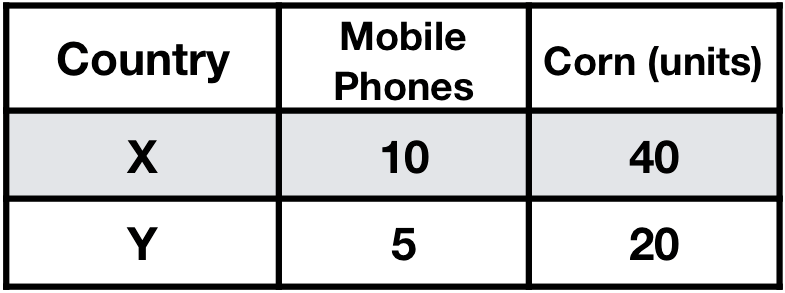
Two countries X and Y both produce mobile phones and corn.

The quantity of the two goods produced by both countries when they divide their resources equally between the two goods is shown in the table below.

Table 68

What can be concluded from this information?

Select ONE answer:

  1. Country X has the comparative advantage in the production of corn.
  2. Country Y has the absolute advantage in the production of corn.
  3. Trade would benefit Country Y but not Country X.
  4. Trade would not benefit either country.

Show your workings to arrive at your answer, and explain and justify your reasons:……………………………………………………………………………………………………………………………………………………………………………………………………………………………………………………………………………………

This multiple choice question is suitable for Economics KS5 classes.

The answer is 4

  1. Country X has the absolute advantage in producing corn but there is no comparative advantage as its opportunity cost of producing one unit of corn is the same as in Country Y i.e. 1⁄4 mobile phone,
  2. Country Y does not have the absolute advantage in producing corn.
  3. Trade would benefit neither country. They could each get the same number of extra mobile phones by shifting resources internally.
  4. Correct: There is no comparative advantage in this case. The opportunity cost of producing 1 mobile phone is 4 units of corn in both countries.


Creative Commons License
This work is licensed under a Creative Commons Attribution 4.0 International License.
Economics Multiple Choice Question – 7 August 2019

The home of multiple choice questions for all your KS3, KS4 and KS5 Business Studies, Economics and Accounting requirements.

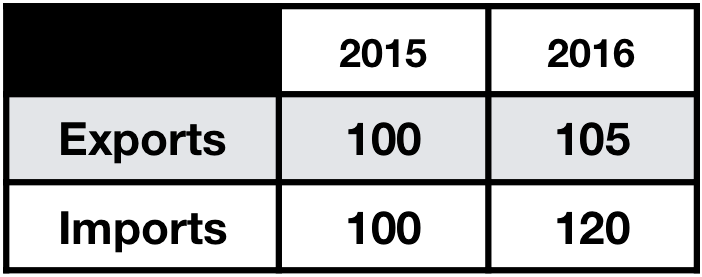
The table below shows the price indices for a country’s exports and imports in 2015 and 2016.

Table 66
What was the country’s terms of trade in 2016?

Select ONE answer:

  1. 0.875
  2. 1.143
  3. 87.5
  4. 114.3

Show your workings to arrive at your answer, and explain and justify your reasons:……………………………………………………………………………………………………………………………………………………………………………………………………………………………………………………………………………………

This multiple choice question is suitable for Economics KS5 classes.

The answer is 3

  1. Incorrect calculation: 105/120
  2. Incorrect calculation: 120/105
  3. Correct: Index of export prices/index of import prices x 100 = 105/120 x 100.
  4. Incorrect calculation: 120/105 x 100.


Creative Commons License
This work is licensed under a Creative Commons Attribution 4.0 International License.