
Accounting Multiple Choice Question – 1 January 2018

The home of multiple choice questions for all your KS3, KS4 and KS5 Business Studies, Economics and Accounting requirements.

Woodpecker Ltd provided a list of its assets and liabilities as at 31 December 2016 as follows.

  • Long-Term Assets £300k
  • Inventory £85k
  • Accounts Receivables £40k
  • Bank Account £10k
  • Cash £5K
  • Accounts Payable £65k
  • Long-term Bank Loan £700k
  • Reserves £125k
  • Share Capital £100kRevenue £3,800k
  • Cost-of-Sales £2,400k
  • Net Profit Margin £300k
  • Purchases £1,200k

What is Woodpecker’s Gross Profit Margin Percentage?

Select ONE answer:

  1. 34.86
  2. 36.84
  3. 7.89
  4. 58.33
  5. 12.87

Show your workings to arrive at your answer, and explain and justify your reasons:
……………………………………………………………………………………………………………………………………………………………………………………………………………………………………………………………………………………

This is multiple choice question is suitable for Accounting KS5 classes.

The answer is 2 – £3,800k – £2,400k = £1,400k / £3,800k * 100 = 36.84%

Creative Commons License
This work is licensed under a Creative Commons Attribution 4.0 International License.
Accounting Multiple Choice Question – 21 November 2017

The home of multiple choice questions for all your KS3, KS4 and KS5 Business Studies, Economics and Accounting requirements.

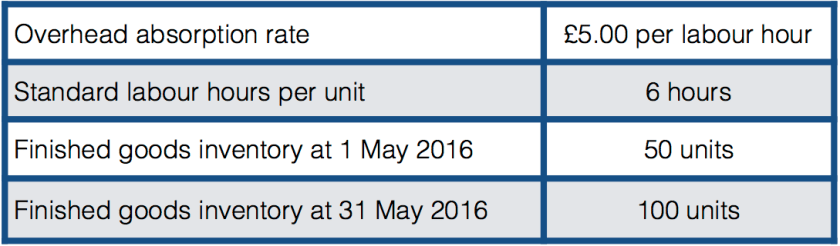
The following information is available for Product Z.

Table 18

What would be the difference between the profit for the month using absorption costing and the profit for the month using marginal costing?

Select ONE answer:

  1. Absorption costing profit would be £500 lower
  2. Absorption costing profit would be £1,500 higher
  3. Absorption costing profit would be £1,500 lower
  4. Absorption costing profit would be £3,000 higher
  5. Absorption costing profit would be £3,000 lower

Show your workings to arrive at your answer, and explain and justify your reasons:
……………………………………………………………………………………………………………………………………………………………………………………………………………………………………………………………………………………

This is multiple choice question is suitable for Accounting KS5 classes.

The answer is 2 – There has been an increase of 50 units in inventory. Each one has absorbed £30 of overhead (£5*6 hours) which means that £1,500 of extra profit in the month will have been generated by an increase in current assets.

Creative Commons License
This work is licensed under a Creative Commons Attribution 4.0 International License.

Accounting Multiple Choice Question – 20 November 2017

The home of multiple choice questions for all your KS3, KS4 and KS5 Business Studies, Economics and Accounting requirements.

The following information is available for the single product manufactured by a business.

Table 17

How many units must the business sell to produce an annual profit of £80 000?

Select ONE answer:

  1. 7,477 units
  2. 14,036 units
  3. 15,888 units
  4. 29,825 units
  5. 38,555 units

Show your workings to arrive at your answer, and explain and justify your reasons:
……………………………………………………………………………………………………………………………………………………………………………………………………………………………………………………………………………………

This is multiple choice question is suitable for Accounting KS5 classes.

The answer is 3 – The contribution per unit is £10.70. If you multiply it by 15,888 units the contribution is £170,001.60 which if you take away the £90,000 of fixed costs leaves you with an annual profit of £80,000. The budgeted production information is a distraction.

Creative Commons License
This work is licensed under a Creative Commons Attribution 4.0 International License.

Accounting Multiple Choice Question – 19 November 2017

The home of multiple choice questions for all your KS3, KS4 and KS5 Business Studies, Economics and Accounting requirements.

The following budgeted information is available for Product Y for August 2016.

Table 16

How many kg of material will be purchased during July 2016?

Select ONE answer:

11,200 kg
13,000 kg
15,200 kg
17,000 kg
21,000 kg

Show your workings to arrive at your answer, and explain and justify your reasons:
……………………………………………………………………………………………………………………………………………………………………………………………………………………………………………………………………………………

This is multiple choice question is suitable for Accounting KS5 classes.

The answer is 3 – We assume that the business purchased at least the quantity required to make the budgeted sales i.e. 3,000 * 5kg or 15,000 kg. The increase in finished goods inventory would necessitate in theory 400 units * 5 kg of extra purchases or 2,000 kg making a total of 17,000 kg. However, the decrease in raw material inventory of 1,800 kg means that the actual purchases of the month would be 17,000 kg – 1,800 kg = 15,200 kg.

Creative Commons License
This work is licensed under a Creative Commons Attribution 4.0 International License.

Accounting Multiple Choice Question – 18 November 2017

The home of multiple choice questions for all your KS3, KS4 and KS5 Business Studies, Economics and Accounting requirements.

A business operates a system of absorption costing. The business apportions factory administration overheads to the four departments: Cutting; Welding; Finishing and Stores based on the number of employees in each department.

Table 15

The factory administration overheads are forecast to be £175 770.

How much of the factory administration overheads will be apportioned to the Finishing department?

Select ONE answer:

  1. £12,555
  2. £37,655
  3. £43,942
  4. £58,590
  5. £65,940

Show your workings to arrive at your answer, and explain and justify your reasons:
……………………………………………………………………………………………………………………………………………………………………………………………………………………………………………………………………………………

This is multiple choice question is suitable for Accounting KS5 classes.

The answer is 2 – the total number of employees in the business are 70 (25+20+15+10). Finishing makes up 15/70 or 21.43% which multiplied into the administration overhead of £175,770 equals £37,665.

Creative Commons License
This work is licensed under a Creative Commons Attribution 4.0 International License.