
Accounting Multiple Choice Question – 12 November 2017

The home of multiple choice questions for all your KS3, KS4 and KS5 Business Studies, Economics and Accounting requirements.

Which formula is used to calculate the overhead absorption rate?

Select ONE answer:

  1. Actual overheads / actual activity
  2. Actual overheads / budgeted activity
  3. Budgeted overheads / actual activity
  4. Budgeted overheads / budgeted activity
  5. Budgeted overheads / managed activity

What is the purpose of the overhead absorption rate?……………………………………………………………………………………………………………………………………………………………………………………………………………………………………………………………………………………

This is multiple choice question is suitable for Accounting KS5 classes.

The answer is 4 – Overhead absorption rates are our attempt at coming up with the best ‘guess’ of how much overhead should be given to a product. In traditional costing systems, the rates are likely to be based on machine hours or labour hours. The process is a little more refined in activity based costing, but the intention is still the same: we are trying to find an equitable way of sharing out the overheads to products and are therefore looking for a method that relates the absorption base to the incidence of the overheads (establish a ‘causal link’). If a business is machine intensive, machine hours would be the most appropriate base as the overheads would be related to machine usage. But this is taking a very wide view: it would be better to break the business down into separate departments and choose individual rates for each department. In order for the business to move along and not wait a full year before it can sell its products we need to forecast the overheads and forecast the total hours to be used when making all of our products (assuming a traditional system), in other words we work with budgeted figures when calculating the overhead absorption rates. The formula to use is Overhead absorption rate = budgeted overhead/budgeted activity.

Creative Commons License
This work is licensed under a Creative Commons Attribution 4.0 International License.
Accounting Multiple Choice Question – 12 October 2017

The home of multiple choice questions for all your KS3, KS4 and KS5 Business Studies, Economics and Accounting requirements.

At 30 November, Charles is owed a total of £72,660 by his customers. His receivables allowance brought forward from the previous year end is £11,700. He estimates that his receivables allowance should be equivalent to 15% of the amounts due from customers.

What value should be included in the income statement for receivables expense for the year to 30 November?

Select ONE answer:

  1. £801 debit
  2. £10,899 debit
  3. £801 credit
  4. £10,899 credit
  5. £11,700 credit

Show your workings to arrive at your answer, and explain and justify your reasons?……………………………………………………………………………………………………………………………………………………………………………………………………………………………………………………………………………………

This is multiple choice question is suitable for Accounting KS5 classes.

The answer is 3 – The receivables allowance should be equivalent to 15% of the amounts due from customers (£72,660 x 15% = £10,899). If a candidate completes this calculation and then reviews the choices, there is a danger that, because £10,899 is included in two of the choices, one or other of those choices will be selected. This ignores the fact that the amount to be included in the income statement is the movement in the allowance – which has fallen from £11,700 to £10,899, or £801. A reduction in the allowance will be a credit in the income statement, thus the answer is 3.

Creative Commons License
This work is licensed under a Creative Commons Attribution 4.0 International License.
Accounting Multiple Choice Question – 11 October 2017

The home of multiple choice questions for all your KS3, KS4 and KS5 Business Studies, Economics and Accounting requirements.

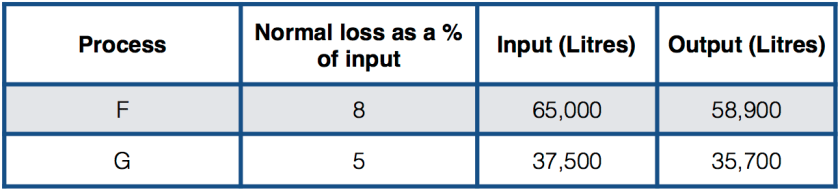
Information relating to two production processes F&G Are as follows:

Table 11

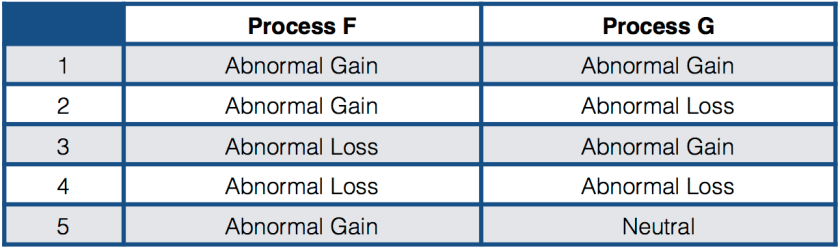
For each process, was there an abnormal loss or an abnormal gain? Select ONE answer:

Table 12

Show your workings to arrive at your answer, and explain and justify your reasons?……………………………………………………………………………………………………………………………………………………………………………………………………………………………………………………………………………………

This is multiple choice question is suitable for Accounting KS5 classes.

The answer is 3 – Process F’s normal loss is 8%, thus expected output is 92% of input. Input was 65,000 litres. Thus expected output would be 59,800 litres. Actual output was 58,900 litres.  As actual output was less than expected, there was an abnormal loss. For process G the normal loss is 5%, thus expected output is 95% of input. Input was 37,500 litres. Thus expected output would be 35,625 litres. Actual output was 35,700 litres. As actual output was more than expected, there was an abnormal gain.

Creative Commons License
This work is licensed under a Creative Commons Attribution 4.0 International License.

Accounting Multiple Choice Question – 10 October 2017

The home of multiple choice questions for all your KS3, KS4 and KS5 Business Studies, Economics and Accounting requirements.

A retailer has never kept accounting records, but wishes to know the value of the business.

Which statement would provide the retailer with the value of the business?

Select ONE answer:

  1. cash flows
  2. changes in equity
  3. financial position
  4. income
  5. order book

Give two reasons why the value of a business is not included in the financial statements: ……………………………………………………………………………………………………………………………………………………………………………………………………………………………………………………………………………………

This is multiple choice question is suitable for Accounting KS5 classes.

The answer is 3 – The statement of financial position is another name for the balance sheet. It is one of the main financial statements and it reports an entity’s assets, liabilities, and the difference in their totals.  The amounts reported on the statement of financial position are the amounts as of the final moment of an accounting period.

Creative Commons License
This work is licensed under a Creative Commons Attribution 4.0 International License.

Accounting Multiple Choice Question – 9 October 2017

The home of multiple choice questions for all your KS3, KS4 and KS5 Business Studies, Economics and Accounting requirements.

The following information is available about rent received for the year ended 31 March 2016.

Table 10

How much should be shown as income in the income statement for the year ended 31 March 2016?

Select ONE answer:

  1. £8,410
  2. £9,250
  3. £9,380
  4. £9,510
  5. £10,350

Show your workings to arrive at your answer, and explain and justify your reasons?……………………………………………………………………………………………………………………………………………………………………………………………………………………………………………………………………………………

This is multiple choice question is suitable for Accounting KS5 classes.

The answer is 1 – Receipts during the year were £9,380 which included the moneys owed to the business in the debit balance brought forward of £550. Because there is a credit balance of £420 at the end of the year, showing moneys are owed by the business to the person renting from them, this too needs to be subtracted leaving the balance of £8,410 being the income of the year.

Creative Commons License
This work is licensed under a Creative Commons Attribution 4.0 International License.