Accounting Multiple Choice Question – 27 April 2019

The home of multiple choice questions for all your KS3, KS4 and KS5 Business Studies, Economics and Accounting requirements.

The following information concerns a retailing firm.

  • Sales during July – £8,200
  • Purchases during July – £6,400
  • Stock at 1 July – £1,300
  • Stock at 31 July – £900
  • Carriage inwards on July purchases – £200

The firm’s cost of sales for July is…?

Select ONE answer:

  1. £6,200
  2. £6,800
  3. £7,000
  4. None of the above.

Show your workings to arrive at your answer, and explain and justify your reasons:

……………………………………………………………………………………………………………………………………………………………………………………………………………………………………………………………………………………

This multiple choice question is suitable for Accounting KS5 classes.

The answer is 3

  • Stock at 1 July                                            £1,300
  • Purchases during July                             + £6,400
  • Carriage inwards on July purchases    + £200
  • Stock at 31 July                                          – £900
  • Cost of sales for July                                 = £7,000


Creative Commons License
This work is licensed under a Creative Commons Attribution 4.0 International License.

Accounting Multiple Choice Question – 26 April 2019

The home of multiple choice questions for all your KS3, KS4 and KS5 Business Studies, Economics and Accounting requirements.

Carriage inwards is included in the cost of sales calculation because …?

Select ONE answer:

  1. it is a cost associated with the purchase of goods.
  2. it should not be shown in the balance sheet.
  3. carriage outwards is shown as an expense in the profit and loss account.
  4. None of the above.

Show your workings to arrive at your answer, and explain and justify your reasons:

……………………………………………………………………………………………………………………………………………………………………………………………………………………………………………………………………………………

This multiple choice question is suitable for Accounting KS5 classes.

The answer is 1

  1. Correct
  2. Although it is correct that carriage inwards should not be shown in the balance sheet, this is not a reason why it should be included in the cost of sales calculation.
  3. Although it is correct to include carriage outwards as an expense in the profit and loss account, this is not a reason why carriage inwards should be included in the cost of sales calculation.


Creative Commons License
This work is licensed under a Creative Commons Attribution 4.0 International License.

Economics Multiple Choice Question – 25 April 2019

The home of multiple choice questions for all your KS3, KS4 and KS5 Business Studies, Economics and Accounting requirements.

The increase in online banking has led to a reduction in the demand for counter staff in high street bank branches.

Which of the following types of unemployment is this most likely to have caused?

Select ONE answer:

  1. Cyclical
  2. Frictional
  3. Seasonal
  4. Structural

Show your workings to arrive at your answer, and explain and justify your reasons:……………………………………………………………………………………………………………………………………………………………………………………………………………………………………………………………………………………

This multiple choice question is suitable for Economics KS5 classes.

The answer is 4

  1. This would have been caused by a decline in aggregate demand.
  2. This arises when workers are in between jobs.
  3. This occurs when workers are unemployed at certain times of the year.
  4. Correct: This is caused by a change in the technology used in the industry – a change in supply conditions.


Creative Commons License
This work is licensed under a Creative Commons Attribution 4.0 International License.

Economics Multiple Choice Question – 24 April 2019

The home of multiple choice questions for all your KS3, KS4 and KS5 Business Studies, Economics and Accounting requirements.

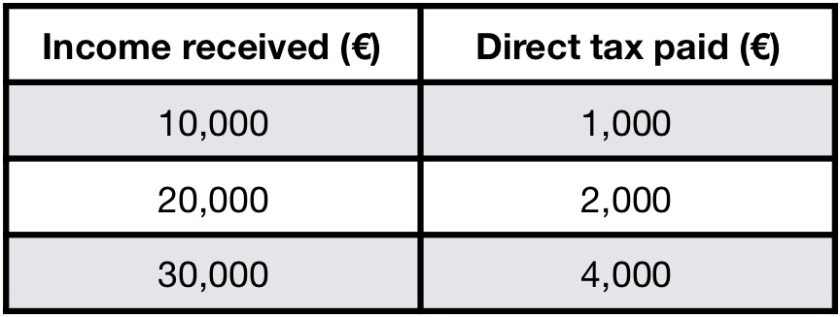
The table shows the amount of direct tax paid by individuals at different levels of income in a country in the eurozone.

Table 56

Which of the following statements about the country’s direct tax system is true?

Select ONE answer:

  1. The system is progressive throughout the income range
  2. The system is proportional from €10 000 to €20 000 only
  3. The system is proportional throughout the income range
  4. The system is regressive from between €20 000 and €30 000

Show your workings to arrive at your answer, and explain and justify your reasons:……………………………………………………………………………………………………………………………………………………………………………………………………………………………………………………………………………………

This multiple choice question is suitable for Economics KS5 classes.

The answer is 2

  1. Tax does indeed rise as income rises but this does not define a progressive system.
  2. Correct: The proportion of income taxed remains at ten percent.
  3. It is indeed proportional in the 10–20,000 range but not thereafter.
  4. Regressive means a lower proportion of tax as income rises. Here it is higher.


Creative Commons License
This work is licensed under a Creative Commons Attribution 4.0 International License.

Economics Multiple Choice Question – 23 April 2019

The home of multiple choice questions for all your KS3, KS4 and KS5 Business Studies, Economics and Accounting requirements.

The table below shows the rate of interest in four countries in 2017 and 2018.

Table 55

Which of the following would best explain the possible aims of the changes in monetary policy that occurred between 2017 and 2018?

Select ONE answer:

  1. Country A was trying to discourage consumer spending / Country B was trying to encourage domestic saving
  2. Country B was trying to encourage consumer spending / Country C was trying to encourage investment by firms
  3. Country C was trying to encourage consumer spending / Country D was trying to discourage domestic saving
  4. Country C was trying to discourage short term capital inflows / Country D was trying to encourage more exports

Show your workings to arrive at your answer, and explain and justify your reasons:……………………………………………………………………………………………………………………………………………………………………………………………………………………………………………………………………………………

This multiple choice question is suitable for Economics KS5 classes.

The answer is 2

  1. Although an increase in the interest rate should discourage consumer spending in Country A, a decrease in the interest rate in Country B should reduce the incentive to save.
  2. Correct: A reduction in the interest rate in Country B should lead to increased consumer spending and a reduction in the interest rate should also be an incentive for firms to borrow and invest in their businesses.
  3. Although a reduction in the interest rate should lead to an increase in consumer spending in Country C, the increase in interest rate in Country D should encourage more foreigners to save in that country.
  4. Although Country C may have reduced their interest rate to make saving in their country less attractive for foreigners, an increase in the interest rate in Country D should actually lead to more demand for their currency, making their exports less competitive abroad.


Creative Commons License
This work is licensed under a Creative Commons Attribution 4.0 International License.