

Economics Multiple Choice Question – 2 August 2019

The home of multiple choice questions for all your KS3, KS4 and KS5 Business Studies, Economics and Accounting requirements.

Christine initially has a disposable income of £500 a week and spends £400.

Christine’s disposable income then rises to £750 a week and her spending to £500.

What is Christine’s marginal propensity to consume?

Select ONE answer:

  1. 0.4
  2. 0.6
  3. 0.67
  4. 1.0

Show your workings to arrive at your answer, and explain and justify your reasons:……………………………………………………………………………………………………………………………………………………………………………………………………………………………………………………………………………………

This multiple choice question is suitable for Economics KS5 classes.

The answer is 1

  1. Correct: mpc is ∆C/∆Y = 100/250.
  2. Incorrect: This is mps. ∆S/∆Y = 150/250.
  3. Incorrect: This is apc. C/Y = 500/750.
  4. Incorrect: This is the new spending/original income. 500/500.


Creative Commons License
This work is licensed under a Creative Commons Attribution 4.0 International License.
Economics Multiple Choice Question – 1 August 2019

The home of multiple choice questions for all your KS3, KS4 and KS5 Business Studies, Economics and Accounting requirements.

Which of the following is an example of current government expenditure?

Select ONE answer:

  1. government spending on building new hospitals
  2. government spending on improving mobile network coverage in rural areas
  3. government spending on increasing the number of lanes on a motorway
  4. government spending on teachers’ salaries

Show your workings to arrive at your answer, and explain and justify your reasons:……………………………………………………………………………………………………………………………………………………………………………………………………………………………………………………………………………………

This multiple choice question is suitable for Economics KS5 classes.

The answer is 4

  1. This is an example of capital government expenditure.
  2. This is an example of capital government expenditure.
  3. This is an example of capital government expenditure.
  4. Correct: Current government expenditure is spending on items such as raw materials and wages. It is short term spending that has to be renewed each year. In contrast, capital spending is spending on physical assets and is long term.


Creative Commons License
This work is licensed under a Creative Commons Attribution 4.0 International License.

Economics Multiple Choice Question – 31 July 2019

The home of multiple choice questions for all your KS3, KS4 and KS5 Business Studies, Economics and Accounting requirements.

Which of the following consists only of injections into the circular flow of income?

Select ONE answer:

  1. exports, government spending and investment
  2. government spending, investment and savings
  3. imports, investment and taxation
  4. imports, savings and taxation

Show your workings to arrive at your answer, and explain and justify your reasons:……………………………………………………………………………………………………………………………………………………………………………………………………………………………………………………………………………………

This multiple choice question is suitable for Economics KS5 classes.

The answer is 1

  1. Correct: Exports, government spending and taxation are all injections.
  2. Although government spending and investment are injections, saving is a leakage.
  3. Investment is an injection but savings and taxation are leakages
  4. Imports, savings and taxation are all leakages.


Creative Commons License
This work is licensed under a Creative Commons Attribution 4.0 International License.

Economics Multiple Choice Question – 30 July 2019

The home of multiple choice questions for all your KS3, KS4 and KS5 Business Studies, Economics and Accounting requirements.

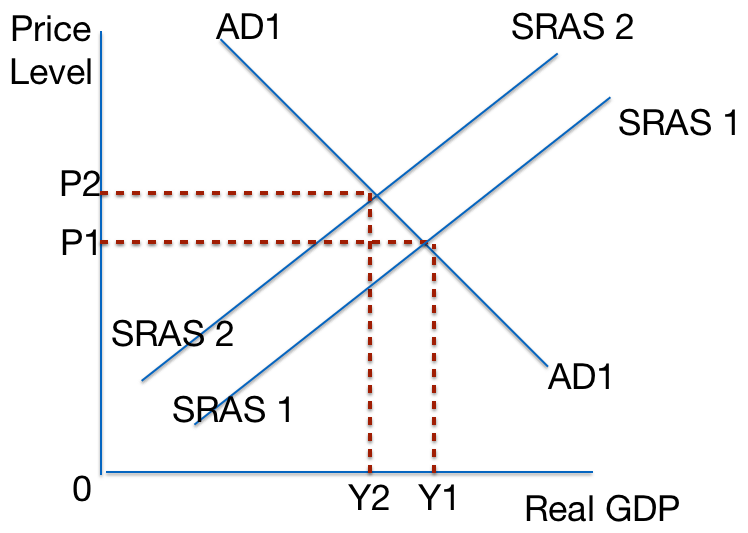
The diagram below shows a change in a country’s macro-equilibrium price level and real GDP.

Diagram 19

Which of the following might have caused this change?

Select ONE answer:

  1. a decrease in business taxes, not matched by a cut in government spending
  2. a decrease in raw material costs, not matched by an increase in corporate taxes
  3. an increase in exports, not matched by an increase in imports
  4. an increase in wages, not matched by an increase in labour productivity

Show your workings to arrive at your answer, and explain and justify your reasons:……………………………………………………………………………………………………………………………………………………………………………………………………………………………………………………………………………………

This multiple choice question is suitable for Economics KS5 classes.

The answer is 4

  1. This would cause an increase in SRAS – a shift to the right of the SRAS curve.
  2. This would cause an increase in SRAS – a shift to the right of the SRAS curve.
  3. This would cause an increase in AD – a shift to the right of the AD curve.
  4. Correct: This would increase costs of production and so cause a shift to the left of the AS curve.


Creative Commons License
This work is licensed under a Creative Commons Attribution 4.0 International License.

Economics Multiple Choice Question – 29 July 2019

The home of multiple choice questions for all your KS3, KS4 and KS5 Business Studies, Economics and Accounting requirements.

Which of the following is a cause of cost-push inflation?

Select ONE answer:

  1. an increase in bank lending
  2. an increase in a budget deficit
  3. an increase in the price of raw materials
  4. an increase in the value of exports sold

Show your workings to arrive at your answer, and explain and justify your reasons:……………………………………………………………………………………………………………………………………………………………………………………………………………………………………………………………………………………

This multiple choice question is suitable for Economics KS5 classes.

The answer is 3

  1. A cause of demand-pull inflation.
  2. A cause of demand-pull inflation.
  3. Correct: An increase in the price of raw materials would raise firms’ costs of production.
  4. A cause of demand-pull inflation.


Creative Commons License
This work is licensed under a Creative Commons Attribution 4.0 International License.