
Economics Multiple Choice Question – 23 July 2019

The home of multiple choice questions for all your KS3, KS4 and KS5 Business Studies, Economics and Accounting requirements.

A firm has total variable costs of £36 000.

Its average fixed cost is £6 and its average total cost is £9.

What is the firm’s total output?

Select ONE answer:

  1. 2,400
  2. 4,000
  3. 6,000
  4. 12,000

Show your workings to arrive at your answer, and explain and justify your reasons:……………………………………………………………………………………………………………………………………………………………………………………………………………………………………………………………………………………

This multiple choice question is suitable for Economics KS5 classes.

The answer is 4

  1. This is the total variable cost divided by average fixed cost plus average total cost.
  2. This is the total variable cost divided by the average total cost.
  3. This is the total variable cost divided by average fixed cost
  4. Correct: average total cost minus average fixed cost gives the average variable cost. In this case, this is £9 – £6 = £3. Total variable cost divided by average variable cost equals output: £36,000/£3 = 12,000.


Creative Commons License
This work is licensed under a Creative Commons Attribution 4.0 International License.
Economics Multiple Choice Question – 22 July 2019

The home of multiple choice questions for all your KS3, KS4 and KS5 Business Studies, Economics and Accounting requirements.

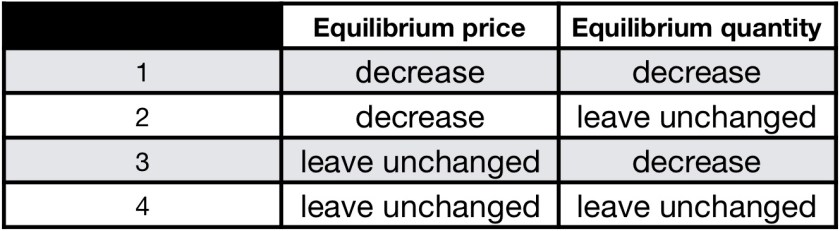
Product X has a price elasticity of demand (PED) of – 3.0. Product Y has a PED of – 0.2.

Which combination of characteristics is correct?

Select ONE answer:

Table 62


Show your workings to arrive at your answer, and explain and justify your reasons:……………………………………………………………………………………………………………………………………………………………………………………………………………………………………………………………………………………

This multiple choice question is suitable for Economics KS5 classes.

The answer is 3

  1. An equal shift to the left of the demand and supply curves will leave the equilibrium price unchanged.
  2. An equal shift to the left of the demand and supply curves will reduce the quantity traded.
  3. Correct: A decrease in supply on its own will push up the price but this would be offset by the downward pressure on the price resulting from a decrease in demand. Both lower supply and lower demand will reduce the quantity traded.
  4. If less is supplied and demand there will fewer products bought and sold.


Creative Commons License
This work is licensed under a Creative Commons Attribution 4.0 International License.
Economics Multiple Choice Question – 21 July 2019

The home of multiple choice questions for all your KS3, KS4 and KS5 Business Studies, Economics and Accounting requirements.

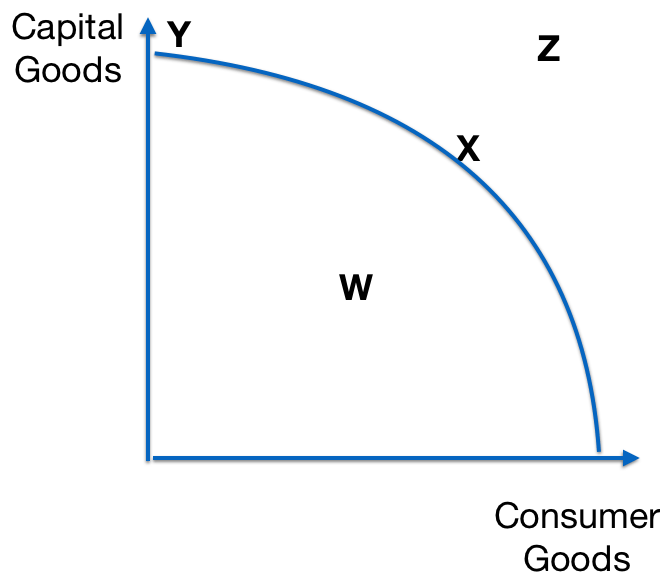
The production possibility curve for an economy producing capital and consumer goods are shown below.

Diagram 18

Which production points are currently attainable?

Select ONE answer:

  1. W only
  2. X and Y only
  3. W, X and Y only
  4. W, X, Y and Z

Show your workings to arrive at your answer, and explain and justify your reasons:……………………………………………………………………………………………………………………………………………………………………………………………………………………………………………………………………………………

This multiple choice question is suitable for Economics KS5 classes.

The answer is 3

  1. W is attainable as it is inside the curve but it is not the only attainable production point.
  2. X and Y are attainable as they are on the curve but W is also attainable.
  3. Correct: W, X and Y are all attainable as they are on or inside the curve – there are sufficient resources to produce these different combinations.
  4. Z is not currently attainable as it is outside the curve indicating there are not sufficient resources to produce the combination.


Creative Commons License
This work is licensed under a Creative Commons Attribution 4.0 International License.

Economics Multiple Choice Question – 20 July 2019

The home of multiple choice questions for all your KS3, KS4 and KS5 Business Studies, Economics and Accounting requirements.

What is NOT a function of the price mechanism in a market economy?

Select ONE answer:

  1. to act as an incentive for supply to respond to changes in demand
  2. to ensure there is an even distribution of income
  3. to indicate changes in consumer tastes and preferences
  4. to ration scarce resources

Show your workings to arrive at your answer, and explain and justify your reasons:……………………………………………………………………………………………………………………………………………………………………………………………………………………………………………………………………………………

This multiple choice question is suitable for Economics KS5 classes.

The answer is 2

  1. The price mechanism provides an incentive (via profits) for firms to adjust their supply to match changes in consumer demand.
  2. Correct: The price mechanism does not ensure an even distribution of income. Indeed, it can result in some people earning very high incomes while other people receive low or no income.
  3. The price mechanism does signal consumer preferences, with more popular products rising in price while less popular products fall in price.
  4. The price mechanism allocates resources to the production of products in high demand.


Creative Commons License
This work is licensed under a Creative Commons Attribution 4.0 International License.

Economics Multiple Choice Question – 19 July 2019

The home of multiple choice questions for all your KS3, KS4 and KS5 Business Studies, Economics and Accounting requirements.

A product has a cross-elasticity of demand of – 0.2 in relation to another product.

What does this indicate?

Select ONE answer:

  1. It is a close complement to another product.
  2. It is a distant complement to another product.
  3. It is a close substitute for another product.
  4. It is a distant substitute for another product.

Show your workings to arrive at your answer, and explain and justify your reasons:……………………………………………………………………………………………………………………………………………………………………………………………………………………………………………………………………………………

This multiple choice question is suitable for Economics KS5 classes.

The answer is 2

  1. A close complement would have a high negative XED.
  2. Correct: the minus figure indicates that the product is a complement and the low figure of 0.2 suggests that it is not very responsive to a change in the price of the product it is purchased to use with it.
  3. A close substitute would have a high positive XED.
  4. A distant substitute would have a low figure such 0.2 but it would be a positive and not a negative figure.


Creative Commons License
This work is licensed under a Creative Commons Attribution 4.0 International License.