
Economics Multiple Choice Question – 18 July 2019

The home of multiple choice questions for all your KS3, KS4 and KS5 Business Studies, Economics and Accounting requirements.

Product X has a price elasticity of demand (PED) of – 3.0. Product Y has a PED of – 0.2.

Which combination of characteristics is correct?

Select ONE answer:
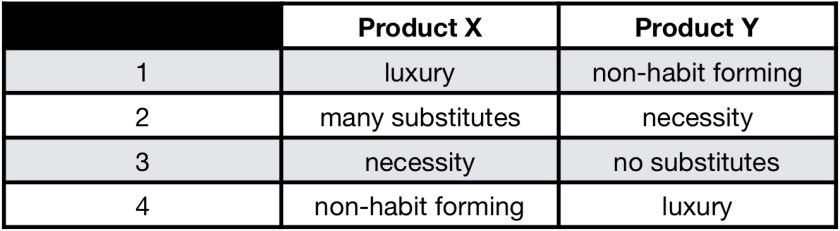
Table 61

Show your workings to arrive at your answer, and explain and justify your reasons:……………………………………………………………………………………………………………………………………………………………………………………………………………………………………………………………………………………

This multiple choice question is suitable for Economics KS5 classes.

The answer is 2

  1. Product X may be a luxury but if Product Y is non-habit forming it is likely to have elastic demand rather than inelastic demand.
  2. Correct: Product X has elastic demand whilst Product Y has inelastic demand. So Product X is likely to have substitutes while Product Y may be a necessity.
  3. In this case, both products are likely to have inelastic demand, which is not the case with Product X.
  4. Product X could be non-habit forming but it is not likely that Product Y is a luxury as luxuries tend to have elastic demand.


Creative Commons License
This work is licensed under a Creative Commons Attribution 4.0 International License.

Economics Multiple Choice Question – 17 July 2019

The home of multiple choice questions for all your KS3, KS4 and KS5 Business Studies, Economics and Accounting requirements.

Which type of demand best explains the relationship between the demand for new houses and the demand for bricklayers?

Select ONE answer:

  1. competitive demand
  2. composite demand
  3. derived demand
  4. joint demand

Show your workings to arrive at your answer, and explain and justify your reasons:……………………………………………………………………………………………………………………………………………………………………………………………………………………………………………………………………………………

This multiple choice question is suitable for Economics KS5 classes.

The answer is 3

  1. Competitive demand occurs when goods are substitutes.
  2. Composite demand occurs when a product has multiple uses.
  3. Correct: derived demand is when the demand for one good or service is dependent on the demand for another good or service.
  4. Joint demand occurs when products are complements.


Creative Commons License
This work is licensed under a Creative Commons Attribution 4.0 International License.

Economics Multiple Choice Question – 16 July 2019

The home of multiple choice questions for all your KS3, KS4 and KS5 Business Studies, Economics and Accounting requirements.

In which situation is a market allocatively efficient?

Select ONE answer:

  1. It is when consumer surplus equals producer surplus.
  2. It is when marginal social benefit equals marginal social cost.
  3. It is when there are both positive consumption externalities and positive production externalities.
  4. It is when the value of external benefits exceeds the value of external costs.

Show your workings to arrive at your answer, and explain and justify your reasons:……………………………………………………………………………………………………………………………………………………………………………………………………………………………………………………………………………………

This multiple choice question is suitable for Economics KS5 classes.

The answer is 2

  1. Allocative efficiency would be achieved where consumer surplus plus producer surplus is maximised.
  2. Correct: Marginal social benefit equalling marginal social cost ensures that the value society places on the last unit produced equals the cost of that unit.
  3. The existence of externalities is likely to mean that market failure will occur.
  4. To ascertain whether allocative efficiency is being achieved, it is not sufficient just to compare external benefits and costs – social benefits and costs needed to be compared.


Creative Commons License
This work is licensed under a Creative Commons Attribution 4.0 International License.

Economics Multiple Choice Question – 15 July 2019

The home of multiple choice questions for all your KS3, KS4 and KS5 Business Studies, Economics and Accounting requirements.

What is the basic economic problem facing all societies?

Select ONE answer:

  1. a divergence between social costs and private costs
  2. unequal distribution of income
  3. unemployment of resources
  4. unlimited wants and scarce resources

Show your workings to arrive at your answer, and explain and justify your reasons:……………………………………………………………………………………………………………………………………………………………………………………………………………………………………………………………………………………

This multiple choice question is suitable for Economics KS5 classes.

The answer is 4

  1. This is a problem in terms of allocation of resources but it is not the basic economic problem
  2. This may be a government priority but it is not the basic economic problem.
  3. This may be a policy issue for the government but it is not the basic economic problem.
  4. Correct: This explains why the basic economic problem of scarcity occurs.


Creative Commons License
This work is licensed under a Creative Commons Attribution 4.0 International License.

Economics Multiple Choice Question – 14 July 2019

The home of multiple choice questions for all your KS3, KS4 and KS5 Business Studies, Economics and Accounting requirements.

Which of the following is an example of government failure?

Select ONE answer:

  1. an increase in obesity caused by overconsumption of sugar
  2. a subsidy on sun cream which reduces the incidence of skin cancer
  3. government health warnings on cigarette packets which deter people from smoking
  4. government imposed rent controls which reduce the amount of rented accommodation available to the poor

Show your workings to arrive at your answer, and explain and justify your reasons:……………………………………………………………………………………………………………………………………………………………………………………………………………………………………………………………………………………

This multiple choice question is suitable for Economics KS5 classes.

The answer is 4

  1. The is an example of market failure.
  2. Harmful effects (and negative externalities) of exposure to the sun are reduced.
  3. This is an example of successful provision of information to reduce overconsumption of a demerit good.
  4. Correct: This will make it more difficult for poor people to rent accommodation.


Creative Commons License
This work is licensed under a Creative Commons Attribution 4.0 International License.